13 Facts About Capri Italy That Surprise First-Time Visitors
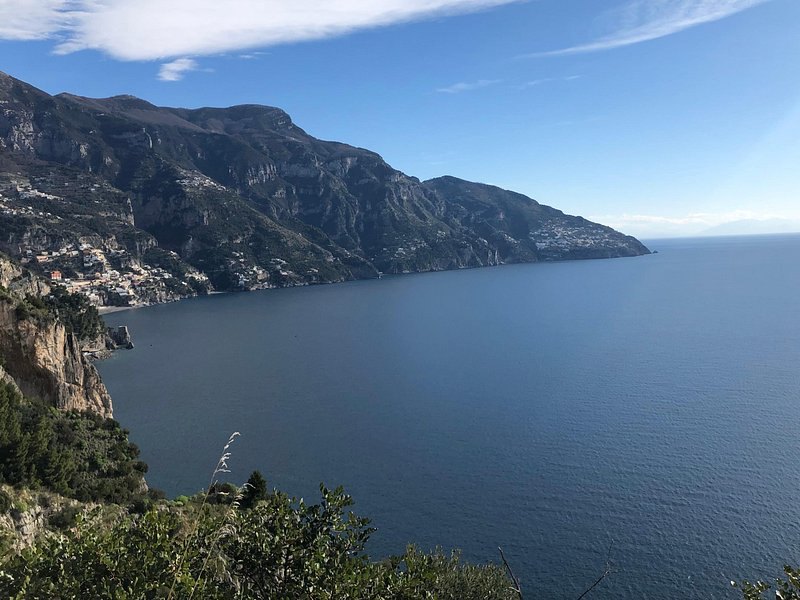
The short answer
Tiberius governed Rome from Capri for ten years. The Blue Grotto's entrance is about a metre high, which is why it closes so often. A blue lizard lives on one of the three Faraglioni and nowhere else. And a German arms manufacturer paid for the island's finest footpath.
1. An emperor ran the Roman Empire from here for ten years
Tiberius moved to Capri permanently in AD 27 and governed from it until he died here in AD 37. Twelve villas on the island are attributed to him. The largest, Villa Jovis, still stands on the cliff at the north-east corner and is one of the best-preserved Roman villas in Italy. Admission is €6, and it is shut on Mondays and for the whole of January and February.
2. The Blue Grotto's entrance is about a metre high
Which is why you lie flat in the rowboat to get in. The opening is around two metres wide and a metre high, so a swell of almost any size makes your transfer unsafe and the cave closes. That decision is taken on the morning, at the cave, by the boatmen — not announced the day before.
3. A blue lizard lives on one rock and nowhere else
Podarcis siculus coeruleus is endemic to Scopolo, the outermost of the three Faraglioni. The usual explanation is camouflage against the water. You will not see one from a boat, and you cannot land.
4. The three stacks have names, and they are different heights
Stella, at 109 m, is still joined to the cliff. Faraglione di Mezzo, at 82 m, is the one with the arch that boats sail through. Scopolo, or Faraglione di Fuori, is 106 m and belongs to the lizards.
5. A German arms manufacturer built the island's best footpath
Friedrich Alfred Krupp commissioned the engineer Emilio Mayer to cut Via Krupp into the cliff between the Gardens of Augustus and Marina Piccola. It was built between 1900 and 1902 and drops about 100 m in a series of hairpins. It has been closed for long stretches since 1976 because of rockfall, and its openings are irregular, so what you can rely on is the view down onto it from the garden terrace.
6. Those gardens were his too, and they were renamed
The Gardens of Augustus were the Krupp Gardens until 1918. They cost you €2.50 today, which makes them the cheapest paid view on the island.
7. There are two towns and two separate councils
Capri and Anacapri are distinct comuni on an island of 10.4 square kilometres with about 13,451 residents between them. The bus between the two takes fifteen minutes and they do not feel like the same place.
8. The Blue Grotto was "rediscovered" in 1826
By the German writer August Kopisch, who turned it into a fixture of the Grand Tour. The Romans had used it long before that.
9. You cannot bring a car, and you would not want to
You cannot take a vehicle across as a non-resident for most of the year. What you get instead is a four-minute funicular at €2.40, buses at the same fare, and open-top taxis at fixed rates of €17 for up to four passengers.
10. Everyone pays to land, and almost nobody notices
You pay a landing tax of €5 per person from April to October and €2.50 the rest of the year. It is normally already inside your ferry ticket, which is why it feels like a rumour rather than a charge.
11. The island's summit is 589 metres, and a chair takes you up it
Monte Solaro, above Anacapri, and a single-seat chairlift takes you up from Piazza Vittoria in twelve minutes for €14 return. Walk it from the same square and you spend about an hour and nothing at all.
12. A Swedish doctor's house is one of the island's best museums
Axel Munthe (1857–1949) built Villa San Michele above Anacapri at the start of the twentieth century and filled it with Roman fragments. It will cost you €12, and do not plan it for February, when it is shut.
13. Most boat fares do not include the Blue Grotto
Of the trips listed here, only two put the €18 admission inside the price. On the others you either pay in cash outside or do not go in at all — and two of them tell you so in their own words. The Blue Grotto tours page sorts them out.
The figures, in one place
| Fact | Figure |
|---|---|
| Island area | 10.4 km² |
| Population | About 13,451 |
| Highest point | Monte Solaro, 589 m |
| Tallest Faraglione | Stella, 109 m |
| Blue Grotto entrance | About 2 m wide, 1 m high |
| Blue Grotto, on a tour boat | €18 (€12 rowboat + €6 entry) |
| Tiberius on Capri | AD 27 to AD 37 |
| Via Krupp built | 1900–1902 |
| Gardens renamed | 1918 |
Nearly all of it costs you nothing to look at. What does not is on the visiting page, and things to do sorts the same island by activity instead of by fact.
Every trip named here is compared on price, hours and what the fare covers at Capri Italy Tours.
Frequently asked questions
Is there a ticket to get onto Capri?
Why does the Blue Grotto close?
What is the difference between Capri and Anacapri?
What does Villa Jovis cost?
Can you swim at the Faraglioni?
Trips that get you to the things above
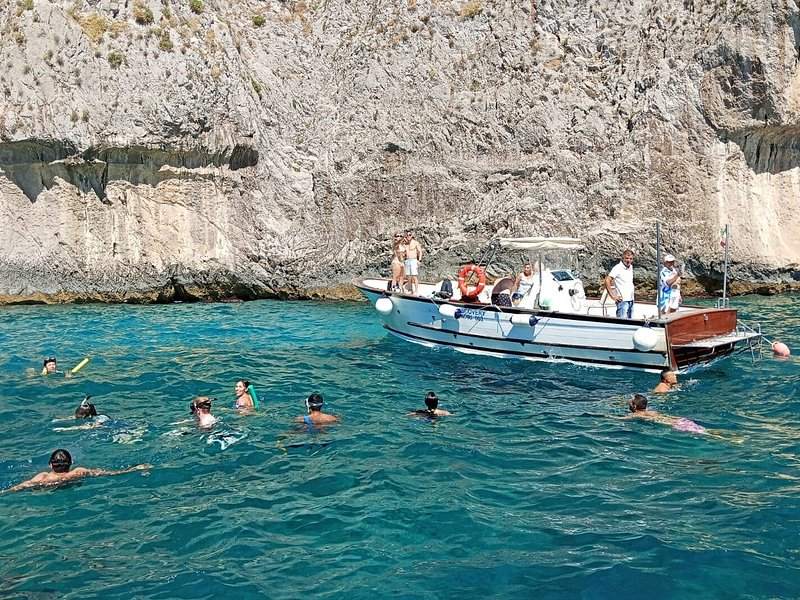
Capri Private Boat Tour with Capri Skipper
Pick a length from one hour round the Faraglioni to six hours of the whole coast, with everything but the cave ticket in the fare.
From $278 per group, up to 6
Check Availability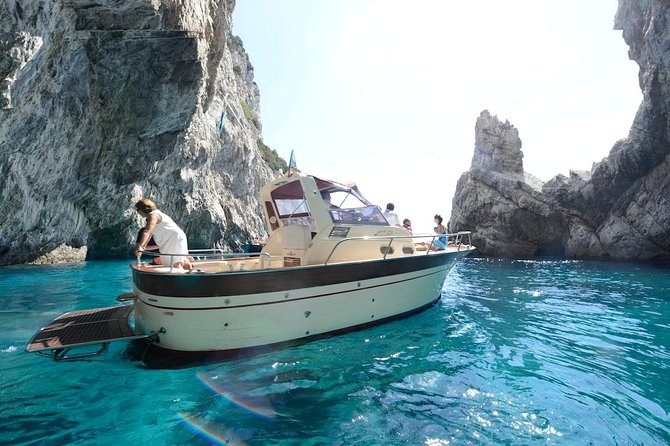
Capri Italy Small-Group Island Boat Ride with Swimming and Limoncello
The full lap in two hours: the caves, the arch, the stacks and a swim, on a shared boat.
From $105 per person
Check Availability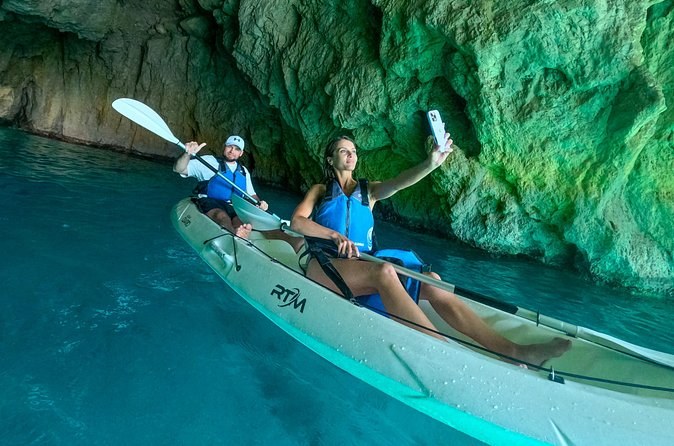
Kayak Tour in Capri Between Caves and Beaches
Paddle in where the motorboats cannot go, with the photographs included in the price.
From $51 per person
Check AvailabilityHalf of this list is only visible from a boat, which is the real argument for spending part of a Capri day on the water.